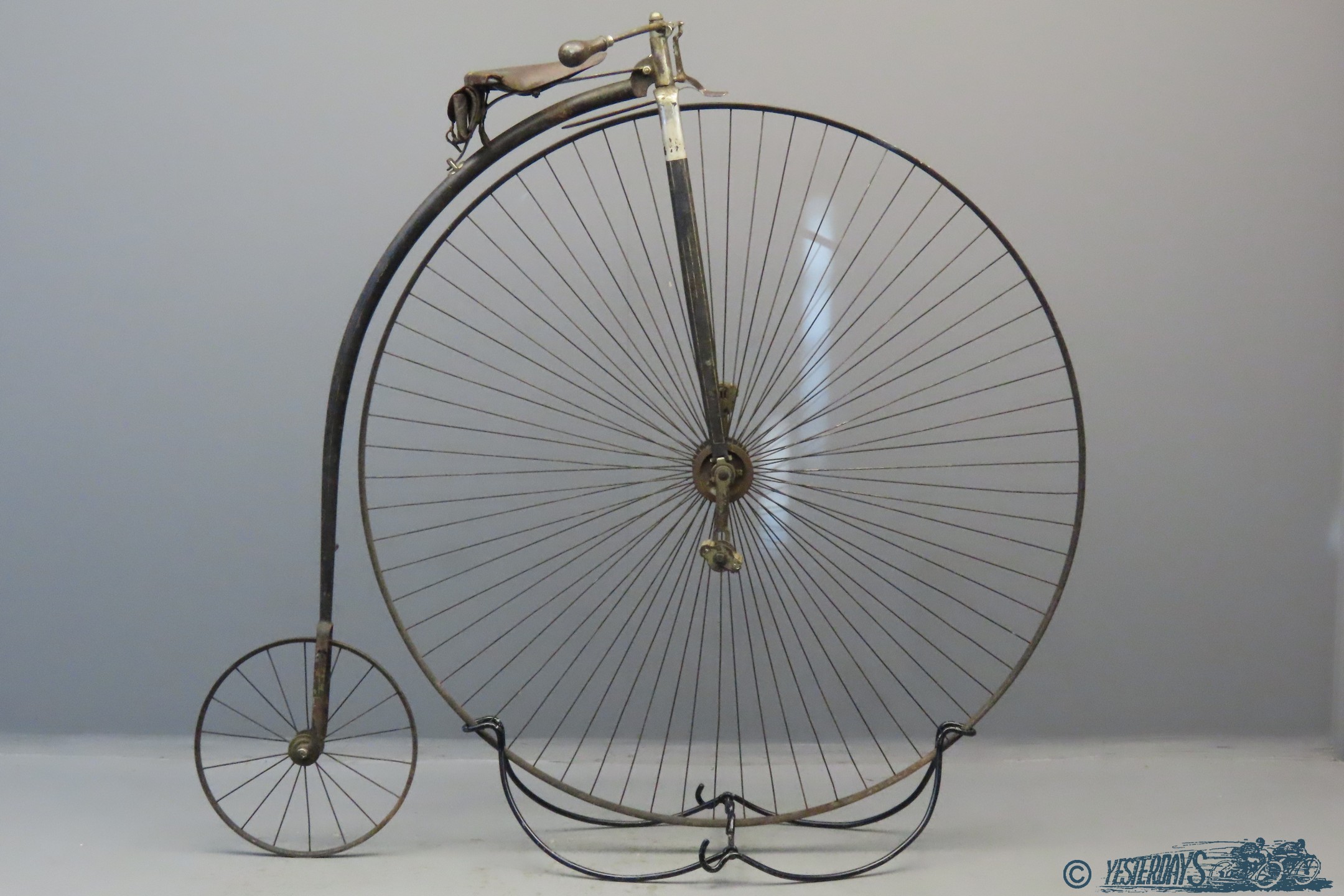
Description Velocipede ca 1869 possibly Michaux It is generally accepted that Pierre Michaux (1813-83), a serrurier or locksmith, and his son Ernest (1849-89) produced his first ‘boneshaker’ by converting a hobby-horse to provide cranks to the front wheel. Henri Michaux claimed in a letter that Pierre Michaux thought of the idea and Ernest executed it. There is some uncertainty when this happened but it appears likely that it was in 1864 (although 1855 and 1861 have been suggested). However there is a competing claim that the boneshaker was invented by P. Lallement. By 1867 the design had evolved from the hobby-horse so that the front wheel was larger than the rear and the backbone and forks were now fashioned from iron rather than wood. The available evidence indicates that they did not start advertising them for sale until 1867 at the World Exhibition in Paris. Under-financed, a loan was obtained from the Olivier brothers (René and Aimé) and the partnership of Michaux & Cie was formed on 7 May 1868 with a move from Ave. Montaigne 29 to a new factory at Arc de Triumph, 19 Rue Jean-Goujon which was later extended to No.27 and 10/12 Ave. Bugeaud. The firm was run by the Olivier brothers who had a 69% share. Machines were advertised priced from Fr.270 to Fr.400 while a tricycle was advertised at Fr.400 and if convertible to a bicycle Fr.450. Improvements such as a cord operated brake and acorn pedals were covered by patent 80637, 24 April 1868. Following a trading dispute with the Olivier brothers in 1869, Michaux left and sold his share of the partnership to the Olivier brothers and the company was dissolved on 17 April 1869. The Olivier brothers then formed Compagnie Parisienne des Vélocipèdes. During the time of Michaux & Cie the change from curved to straight backbones took place, covered in a patent dated 23 June 1868. Also, the first cycle races took place in 1868 using Michaux boneshakers. Michaux began trading as Michaux Père et Cie from Ave. Montaigne 29 and 5-8 Cite Godet de Mauroy with a sleeping partner having been registered on 26 June 1869. A court judgement held that the Michaux name, and patents, was the exclusive property of the Olivier brothers and Michaux could not use them. The public also lost interest in boneshakers and Michaux Père et Cie went into receivership on 18 January 1870. Nameplates were generally oval but Compagnie Parisienne des Vélocipèdes and Michaux Père et Cie plates could be sculpted rectangles. (adapted from: onlinebicyclemuseum.com.uk) This elegant early ex-Falmignoul velocipede bears a rectangular brass identification plate of the Michaux firm. She has a forged iron frame with original saddle pan on leaf spring. Hock foot rests are fitted and the braking is effected by the usual spoon on the rear wheel, operated by turning the handlebars. The driving wheel has a diameter of 35 inch, the rear wheel measures 24 inch. Total length of the machine is 170 cm, handlebar height reaches 125 cm. Velocipede ca 1869 possibly Michaux It is generally accepted that Pierre Michaux (1813-83), a serrurier or locksmith, and his son Ernest (1849-89) produced his first ‘boneshaker’ by converting a hobby-horse to provide cranks to the front wheel. Henri Michaux claimed in a letter that Pierre Michaux thought of the idea and Ernest executed it. There is some uncertainty when this happened but it appears likely that it was in 1864 (although 1855 and 1861 have been suggested). However there is a competing claim that the boneshaker was invented by P. Lallement. By 1867 the design had evolved from the hobby-horse so that the front wheel was larger than the rear and the backbone and forks were now fashioned from iron rather than wood. The available evidence indicates that they did not start advertising them for sale until 1867 at the World Exhibition in Paris. Under-financed, a loan was obtained from the Olivier brothers (René and Aimé) and the partnership of Michaux & Cie was formed on 7 May 1868 with a move from Ave. Montaigne 29 to a new factory at Arc de Triumph, 19 Rue Jean-Goujon which was later extended to No.27 and 10/12 Ave. Bugeaud. The firm was run by the Olivier brothers who had a 69% share. Machines were advertised priced from Fr.270 to Fr.400 while a tricycle was advertised at Fr.400 and if convertible to a bicycle Fr.450. Improvements such as a cord operated brake and acorn pedals were covered by patent 80637, 24 April 1868. Following a trading dispute with the Olivier brothers in 1869, Michaux left and sold his share of the partnership to the Olivier brothers and the company was dissolved on 17 April 1869. The Olivier brothers then formed Compagnie Parisienne des Vélocipèdes. During the time of Michaux & Cie the change from curved to straight backbones took place, covered in a patent dated 23 June 1868. Also, the first cycle races took place in 1868 using Michaux boneshakers. Michaux began trading as Michaux Père et Cie from Ave. Montaigne 29 and 5-8 Cite Godet de Mauroy with a sleeping partner having been registered on 26 June 1869. A court judgement held that the Michaux name, and patents, was the exclusive property of the Olivier brothers and Michaux could not use them. The public also lost interest in boneshakers and Michaux Père et Cie went into receivership on 18 January 1870. Nameplates were generally oval but Compagnie Parisienne des Vélocipèdes and Michaux Père et Cie plates could be sculpted rectangles. (adapted from: onlinebicyclemuseum.com.uk) This elegant early ex-Falmignoul velocipede bears a rectangular brass identification plate of the Michaux firm. She has a forged iron frame with original saddle pan on leaf spring. Hock foot rests are fitted and the braking is effected by the usual spoon on the rear wheel, operated by turning the handlebars. The driving wheel has a diameter of 35 inch, the rear wheel measures 24 inch. Total length of the machine is 170 cm, handlebar height reaches 125 cm.